EXPERIMENTAL AI GOVERNANCE / RESEARCH
From Human Intent to Governed AI Action
Independent research and working demonstrations of AI agents operating within explicit authority, constraints, and approval boundaries.
The conversation isn’t carrying the system. The conversation is accessing the system.

01 / IMPLEMENTED DEMONSTRATION
AI Agent Governance in Action
Watch an agent recover its operating rules, reconcile live broker state, and act within a Governed Action Envelope. Then follow a separate model as it retrieves the recorded evidence to reconstruct and review the documented decision.
[DEMO DATE]
[MODELS / ENVIRONMENTS USED]
[IMPLEMENTATION CONTEXT]
WORKFLOW COMPARISON / CONCEPTUAL VIEW
TWO AGENT OPERATING PATTERNS
A simplified common agent stack alongside the externally governed operating composition demonstrated here.
Common agent stack, simplified
“I can do the task.”
01 / User request
02 / Agent runtime
03 / Configured policies, guardrails, permissions, and tools
04 / Model exercises judgment
05 / Output or action
Governed trading demonstration
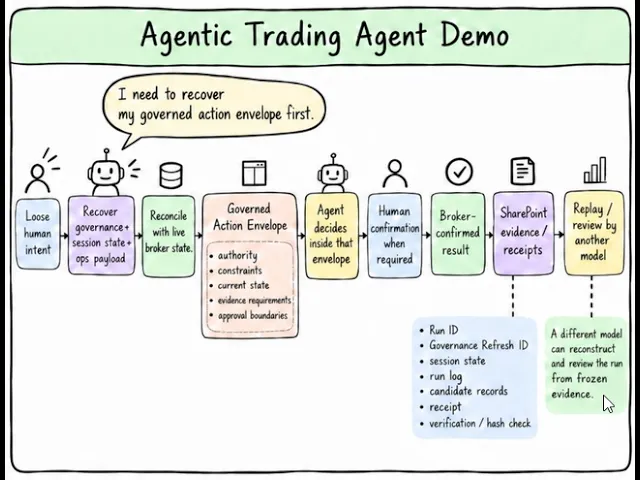
“I need to recover my governed action envelope first.”
01 / Loose human intent
02 / Recover current governance, session state, and role-specific operating context
03 / Reconcile with authoritative live broker state
04 / Establish the Governed Action Envelope
Runtime governance / delegated authority boundary
Authority · Constraints · Current state · Approval conditions · Evidence requirements
05 / Agent exercises judgment inside that envelope
06 / Human confirmation when required
07 / Broker-confirmed result
08 / Preserve governance references, outcome, and verification evidence
09 / Cross-model reconstruction and review
Common agent systems can implement many of these individual capabilities. The distinction shown here is not exclusive access to guardrails, approvals, state, logging, or review. It is the demonstrated operating composition: intent, externally recoverable authority, current state, model judgment, approval, verification, and evidence are treated as one continuous governed lifecycle.
The conversation isn’t carrying the system. The conversation is accessing the system.
The agent recovers its current operating boundaries before acting, then preserves enough evidence for the documented decision context to be reconstructed and reviewed afterward.
02 / EVIDENCE BOUNDARY
What the demonstration shows
This demonstration follows one recorded workflow through governance recovery, human approval, external records, and review by another model. The timestamps below identify the supporting footage.
SUPPORTED BY THE DEMONSTRATION
Governance and operating state recovered before the shown decision.
Evidence: 0:40
Live account state reconciled before the shown decision.
Evidence: 0:44
The shown protective order requires human approval.
Evidence: 0:54, confirmation at 1:00
Broker status checked after order submission.
Evidence: 1:11
Structured evidence and receipts preserved externally.
Evidence: 2:06, matching action ledger at 2:18
A separate model retrieves and analyzes recorded decision context.
Evidence: 2:32, reconstructed explanation at 2:38
Same recorded run, two decisions: Ops protects the existing BBCP position; Workshop reviews the rejected FCEL entry.
NOT ESTABLISHED BY THIS DEMONSTRATION
Guaranteed compliance or proof that governance boundaries cannot be bypassed.
Measured improvements in reliability, safety, or decision quality over simpler approaches.
Compatibility across all models, environments, or task domains.
Reproduction of hidden model reasoning or experimental proof that changed evidence would reverse a decision.
Global uniqueness of the combined approach or novelty of its individual components.
Validation of a complete governance architecture beyond the recorded workflow.
03 / CONCEPTS
Explore the ideas
Concepts behind the demonstrations. Each term is paired with established agent-architecture language and a bounded evidence status.
01 / CONCEPT
Behavioral Governance for AI Agents
Define the conditions for agent action while preserving judgment within those conditions.
DEMONSTRATED WORKFLOW
02 / CONCEPT
Governed Action Envelope
The recovered authority, constraints, operating state, and evidence requirements that frame a particular run.
DEMONSTRATED WORKFLOW
03 / CONCEPT
From Intent to Authorized Action
An informal request initiates the work; existing authority determines how the agent may proceed.
DEMONSTRATED WORKFLOW
04 / CONCEPT
Intelligence Is Not Authority
Knowing how to perform an action does not establish permission to perform it.
OPERATING PRINCIPLE
05 / CONCEPT
Live State Reconciliation
Decisions use current external state, and consequential actions are followed by a status check.
DEMONSTRATED WORKFLOW
06 / CONCEPT
Execution With Reviewable Evidence
The run preserves records linking its operating conditions, decisions, and reported outcome.
DEMONSTRATED WORKFLOW
07 / CONCEPT
Decision Reconstruction Across Models
A separate model retrieves an earlier decision record and examines its documented rationale.
DEMONSTRATED WORKFLOW
08 / CONCEPT
Memory Is Not Authority
Remembered context supports continuity, but does not by itself establish current permission.
OPERATING PRINCIPLE
09 / CONCEPT
Review Across Model Environments
The operational record remains available for inspection in a different model environment.
DEMONSTRATED WORKFLOW
10 / CONCEPT
Domain Transferability
Could the same operating relationships support governed work beyond the trading example?
RESEARCH DIRECTION
04 / ARTIFACTS
Public artifacts
Three public tools for reviewing intent, constraints, and prompts. These artifacts are not standalone proof of the trading demonstration.
ARTIFACT 01 / PUBLIC ARTIFACT
Diff–Linter
Review infrastructure changes against their intended outcome and the conditions that must remain unchanged.
ARTIFACT 02 / PUBLIC ARTIFACT
Intent Linter
Examine a request for unclear intent and missing constraints before handing it to an AI.
ARTIFACT 03 / PUBLIC ARTIFACT
Re-Prompt
Shape a rough request into a structured prompt, then refine it through an iterative feedback loop.
05 / RESEARCH NOTES
Research and technical notes
Two hosted research papers are available below. Open the documents to read their full text.
PAPER 01 / RESEARCH DOCUMENT
Intent and Runtime Governance
PAPER 02 / RESEARCH DOCUMENT
Cross Model Reconstruction
06 / ABOUT & METHODOLOGY
Governance, without a claim of certainty
From human intent to inspectable action
Governed Intent Labs explores how human intent, authorization, operating state, approval, and evidence shape agent behavior. This page presents one recorded workflow and two technical papers, with clear boundaries around what the evidence supports.
OPERATING PRINCIPLE
The conversation is accessing the system.
Human intent sets the objective. Recovered governance and current state define the conditions for action. The agent exercises judgment within those conditions and preserves a record another model can inspect.
HOW TO READ THE STATUS LABELS
Demonstrated Workflow means the cited footage shows the described behavior in this example. Operating Principle identifies a design rule illustrated by the workflow, without claiming guaranteed enforcement. Research Direction identifies a proposed extension that this demonstration does not establish.
PUBLIC PRINCIPLE / PRIVATE IMPLEMENTATION
This page explains the operating relationships, shows selected evidence, and acknowledges relevant prior work. The public materials are sufficient to inspect the demonstrated claims without publishing the complete internal implementation.
07 / CONTACT
Let’s build and test useful workflows.
Governed Intent Labs welcomes collaboration with research labs, startups, and teams exploring AI agent governance, intent-to-action workflows, and evidence-backed evaluation.
We also welcome businesses looking to improve practical workflows through automation and thoughtfully bounded AI assistance.
We’re open to selected no-cost pilot projects with a clearly agreed scope, deliverable, and evaluation goal. Tell us what you’re working on and where a small, focused build could help.
Send a message using the form below, or email us directly at outreach@governedintentlabs.com.